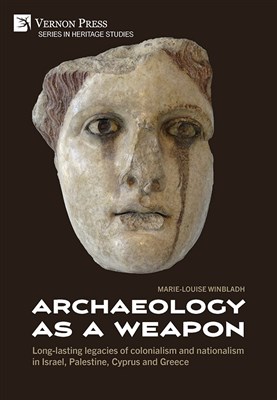
Archaeology as a Weapon: Long-lasting legacies of colonialism and nationalism in Israel, Palestine, Cyprus and Greece
Book Reviews
Archaeology as a Weapon
Marie-Louise Winbladh
Vernon Press, 2025, ISBN: 979-8-8819-0273-5, Series in Heritage Studies
................
Review by Chemi Shiff, Independent Researcher,
Emek Shaveh (NGO), Israel, chemi@emekshaveh.org
Marie-Louise Winbladh, Archaeology as a Weapon: Long-Lasting Legacies of Colonialism and Nationalism in Israel, Palestine, Cyprus, and Greece. (Wilmington: Vernon Press, 2025, xxii and 344pp., 88 b/w illustr., hbk, ISBN 979-8-8819-0273-5) | European Journal of Archaeology | Cambridge Core
https://share.google/W4hjG9PdetcNdlUhp
...............
Review by Ghattas J. Sayej, Agder County Council, Norway - reviewed Autumn 2025.
Impact
Marie-Louise Winbladh’s Archaeology as a Weapon is a landmark contribution to critical heritage studies. It dismantles the assumption that archaeology is a neutral science, revealing how it has been instrumentalized to legitimize nationalist ideologies, colonial expansion, and territorial claims. The book’s impact resonates across multiple disciplines - archaeology, history, archaeogenetics, political science and museum studies - and it makes a significant contribution to debates on cultural heritage protection, particularly in conflict zones.
Winbladh’s documentation of looting, destruction, and ideological manipulation of archaeological sites in Israel/Palestine, Cyprus, and Greece is highly relevant to international legal frameworks and heritage ethics. Her call for a decolonized archaeology is both legitimate and urgent.
Review
Archaeology as a Weapon is structured into four regional chapters and is thoroughly illustrated and supported by hundreds of references. The author combines field experience with critical analyses, offering a compelling narrative that is both scholarly and accessible.
Winbladh’s central idea - that archaeology has been weaponized - is supported by many case studies, genetic research and institutional critique. The book is a valuable reference for those who are interested in cultural heritage, as well as students, scholars and politicians.
Archaeology and Power
Winbladh situates archaeology within a global framework of colonialism and nationalism. Drawing on scholars such as Yannis Hamilakis, Rafi Greenberg, Israel Finkelstein, Susan Pollock, and Neil Asher Silberman, she explores how archaeology has been - and continues to be - used to construct national myths and suppress alternative histories.
The book also exposes the misuse of archaeogenetics to support racial purity narratives, while highlighting shared ancestry among groups such as Israeli Jews and Palestinian Arabs, Cypriots and Greeks.
Museums and heritage institutions are also examined for their role in perpetuating biased narratives and displaying looted artefacts.
Israel and Palestine
Chapter One critiques biblical archaeology’s role in legitimizing Zionist claims. Winbladh documents how settler organizations and evangelical Christian groups fund excavations in East Jerusalem and the West Bank, often violating international law and excluding Palestinian archaeologists. The excavation in Silwan, East Jerusalem, is presented as a case study in nationalist archaeology, where Zionist organizations such as Elad attempt to manipulate evidence to proclaim the discovery of “the City of David.”
Many excavations in Israel are promoted with the explicit aim of reinforcing a Jewish historical narrative. Several prominent Israeli scholars have criticized this nationalist archaeology, arguing that biblical narratives lack historical evidence. These critiques have been known for decades but remain largely ignored by the Israeli public and political establishment.
The author also addresses looting and highlights the role of the U.S. art dealer Hobby Lobby in supporting Zionism and smuggling artefacts from Iraq, Syria, Jordan, and Palestine - a scandal that underscores the ideological dimensions of the antiquities trade.
Chapter Two turns to Palestinian archaeology, noting efforts by some intellectuals to establish a direct link to the Canaanites as evidence of pre-Israelite presence - a narrative that does not fully reflect the complex realities on the ground.
Points requiring clarification
Page 101: The statement that “the Scrolls were removed from the Palestine Archaeological Museum in East Jerusalem… They are now exhibited in the Rockefeller Archaeological Museum in Jerusalem” is inaccurate. The Palestine Archaeological Museum is the Rockefeller Museum, located in East Jerusalem, whereas the Dead Sea Scrolls are exhibited in West Jerusalem at the Shrine of the Book.
Page 112: Glock and his students excavated the Neolithic site of Tell Jenin (1977-1984) and Tell Ti’innik (Tell Ta’anach) near Jenin in 1987. Glock was assassinated in front of his colleague Ghada Ziadeh’s house while visiting her in Birzeit.
Page 113 - Note 9: Gaza is not Ashkelon. Ashkelon (Arabic: Askalan) is a separate city located in Israel, approximately 13 km north of the Gaza Strip.
The chapter concludes by emphasizing DNA analyses that reveal a shared origin among Israelis and Palestinians - Jews, Christians, and Muslims alike.
Cyprus
Chapter Three examines how archaeology in Cyprus has been used to assert Greek identity while marginalizing Turkish Cypriot heritage. Winbladh critiques the legacies of British colonialism and the Turkish invasion, as well as the politicization of museum narratives. She documents also the looting of over 60,000 artefacts from Northern Cyprus since 1974, to finance rebel groups.
Greece
Chapter Four explores how Classical archaeology in Greece has been appropriated by far-right movements such as Golden Dawn. Winbladh analyses rituals at Thermopylae, the glorification of Spartan militarism against the Persians in 480 BCE, and the use of ancient symbols to promote racial purity.
Museums are criticized for ignoring Ottoman and Albanian contributions to Greek history, reinforcing narratives of Christian Greek superiority. The misuse of archaeogenetics is exposed as a tool for nationalist propaganda.
Ethical Imperatives
In her conclusion, Winbladh identifies recurring patterns across these regions: archaeology is used to assert national legitimacy, erase alternative identities, and suppress opposition. She calls for a decolonized archaeology - one that acknowledges shared histories, promotes ethical standards, and includes marginalized voices.
The book commends initiatives such as Emek Shaveh (based in Jerusalem) and Forensic Architecture (based in London), for promoting inclusive heritage and documenting destruction, while condemning the global antiquities trade and provenance fraud.
Conclusion
Archaeology as a Weapon is courageous and intellectually rigorous work that confronts the discipline’s political entanglements. It is essential reading for students, scholars, and policymakers engaged in cultural heritage in conflict zones.
Winbladh’s scholarship is meticulous, her critique fearless, and her message unequivocal: archaeology must serve truth, not power.
.............
After 3 years of hard work my book is finally published! I can't decide if it's worth reading but at least a lot of interesting information is provided... and the cover is rather attractive.
I have dedicated the book to archaeologists and friends in Northern Cyprus and Palestine.
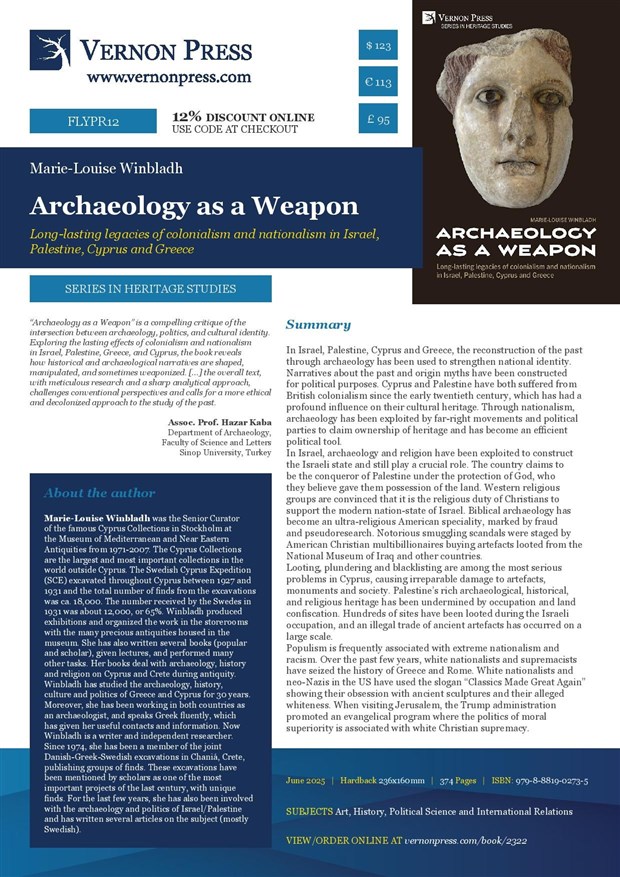
It wasn't possible to add a pdf but here is some info -
https://vernonpress.com/book/2322
Archaeology as a Weapon: Long-lasting legacies of colonialism and nationalism in Israel, Palestine, Cyprus and Greece
by Marie-Louise Winbladh
“Archaeology as a Weapon” is a compelling critique of the intersection between archaeology, politics, and cultural identity. Exploring the lasting effects of colonialism and nationalism in Israel, Palestine, Greece, and Cyprus, the book reveals how historical and archaeological narratives are shaped, manipulated, and sometimes weaponized. […] the overall text, with meticulous research and a sharp analytical approach, challenges conventional perspectives and calls for a more ethical and decolonized approach to the study of the past.
Assoc. Prof. Hazar Kaba
Department of Archaeology, Faculty of Science and Letters
Sinop University, Turkey
..........